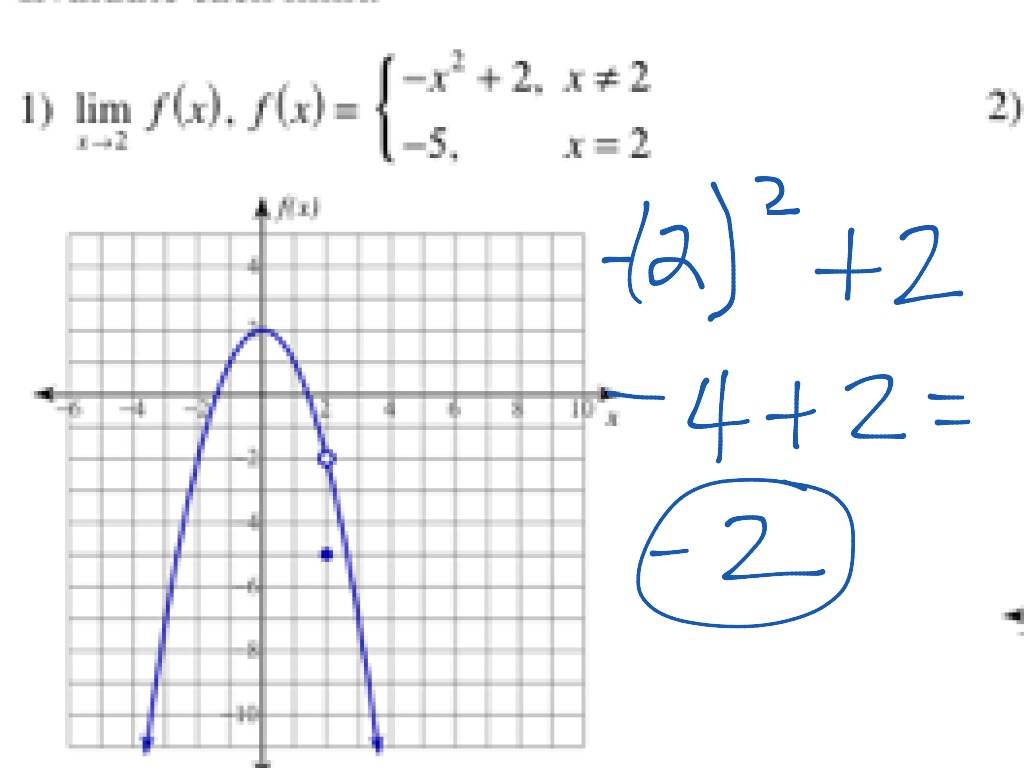
Removable Discontinuity Definition. Hence, the limit if the function f does not exist. In other words, condition 1.
ShowMe discontinuities from www.showme.com
In infinite discontinuity, either one or both right hand and left hand limit do not exist or is infinite. Hence, the limit if the function f does not exist. There is a gap at that location when you are looking at the graph.
Avoidable, Jump And Essential Discontinuity.
The term removable discontinuity is sometimes broadened to include a removable singularity, in which the limits in both directions exist and are equal, while the function is undefined at the point. A removable discontinuity is sometimes called a point discontinuity , because the function isn’t defined at a single (miniscule point). It is called 'removable discontinuity'.
When A Function Is Not Continuous At A Point, Then We Can Say It Is Discontinuous At That Point.
Removable discontinuities are characterized by the fact that the limit exists. Do discontinuous functions have limits? A removable discontinuity is a point on the graph that is undefined or does not fit the rest of the graph.
A Removable Discontinuity Occurs In The Graph Of A Rational Function At X=A If A Is A Zero For A Factor In The Denominator That Is Common With A Factor In The Numerator.
Limx→af(x) ≠ f(a) lim x → a f ( x) ≠ f ( a) When graphed, a removable discontinuity is marked by an open circle on the graph at the point where the graph is undefined or is a different value like. Removable types of discontinuities :
There Is A Gap At That Location When You Are Looking At The Graph.
Therefore, f(x) = sin(1/x) has a discontinuity at x = 0, of the infinite oscillation variety. So, in this case we can redefine function such that lim x. If you just define the function to be − 4 at z = − 2 you have the function z − 2, which is nicely continuous.
Formally, A Removable Discontinuity Is One At Which The Limit Of The Function Exists But Does Not Equal The Value Of The Function At That Point;
Lindner shared this question 14 years ago. A discontinuity removable at a point x=a if the limx→af (x) exists and this limit is finite. Since these factors can be cancelled, the discontinuity is removed.