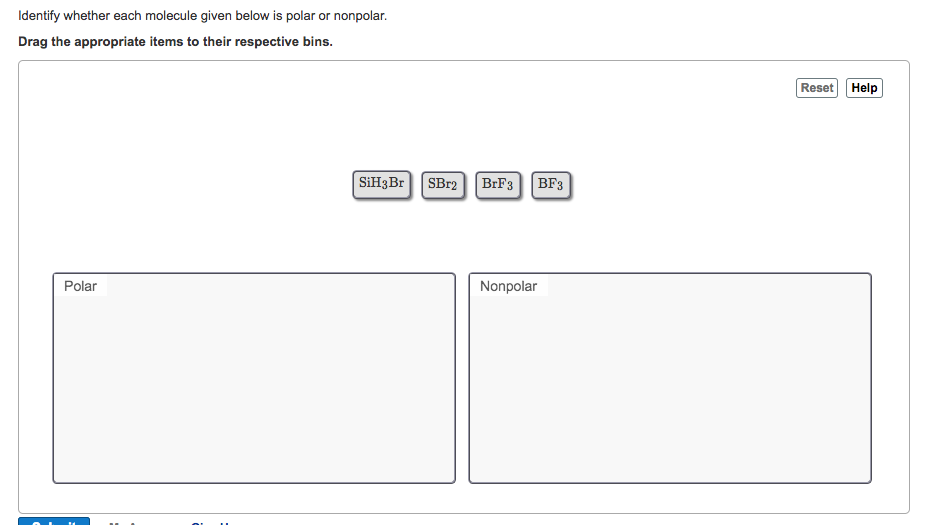
Identify Whether Each Molecule Given Below Is Polar Or Nonpolar
Identify Whether Each Molecule Given Below Is Polar Or Nonpolar. The molecule is a polar molecule.explanation :polar molecule : Determine whether each molecule given below is polar or nonpolar || answer :
Solved Identify Whether Each Molecule Given Below Is Pola from www.chegg.com
A polar molecule with two or more polar bonds must have an asymmetric geometry so that the bond dipoles do not cancel each other. So the first molecule from prom 57 is a phosphorous trifle ride pf three. Drag the appropriate items to their respective bins.
Find The Total Count Of Valence Electrons To Molecules.
Drag the appropriate items to their respective bins. Tap card to see definition 👆. Nonpolar molecules occur when electrons are shared equal between atoms of a diatomic molecule or when polar bonds in a larger molecule cancel.
Identify Whether Each Molecule Given Below Is Polar Or Nonpolar.
For the following molecules, determine. The molecule is a polar molecule.explanation :polar molecule : Drag the appropriate items to their respective bins.
(Not Applicable If The Structure Is An Ion.
Pf5 is a nonpolar molecule because when you consider its horizontal and vertical planes electron pulls balance themselves out to achieve a neutral conformation. Determine whether each molecule given below is polar or nonpolar || answer : Polar molecules occur when there is an electronegativity difference between the bonded atoms.
Identify Whether Each Molecule Given Below Is Polar Or Nonpolar.
Answer to identify the bonds in each molecule as polar or nonpolar. The molecules having positively charged end and negatively charged end due to the difference in the charges of atoms present in the molecules are polar molecules. H h h h h h h :.
Identify Whether Each Molecule Given Below Is Polar Or Nonpolarsih3Br Sbr2 Brf3 Bf3.
The molecular geometry is given in parentheses. The arrangement of bonds around the molecule. In this problem, we're asked to determine whether the molecules which are discussed in an earlier problem problem 57 our polar or non polar.