Lithium Oxide Chemical Formula. In its solid state lithium oxide adopts an antifluorite structure that we can relate to the \( caf_{2} \), fluorite structure with li cation substitute for fluoride anions and the oxide anions substitute for calcium anion. What is a reducing agent in a reaction?
Learning results describe the types of elements that form an ionic connection. What is the formula for lithium oxide. Lithium oxide (li 2 o) content.
For The Ionic Compound Lithium Oxide Upvote3Downvote1Shareanswer Itionic Compounds, Naming And Formula Writingablithium Oxideli2Olithium Sulfideli2Slithium Selenideli2Sesodium Oxidena2Salso Question Is, What The Chemical Formula For Tetraphosphorus Triselenide Tetraphosphorus Triselenidepubchem Cid 136992Chemical.
The lithium oxide is an inorganic substance without color. Learning results describe the types of elements that form an ionic connection. Lithium nickel manganese cobalt oxide product number:
Chemical Formula For Lithium Oxide.
Lithium cobalt oxide, sometimes called lithium cobaltate or lithium cobaltite, is a chemical compound with formula licoo 2. Lithium carbonate equivalent (lce) multiply by: The amounts of phosphorous, hydrogen and oxygen are affected by the subscripts outside the parentheses.
Lithium Oxide (Li 2 O) Content.
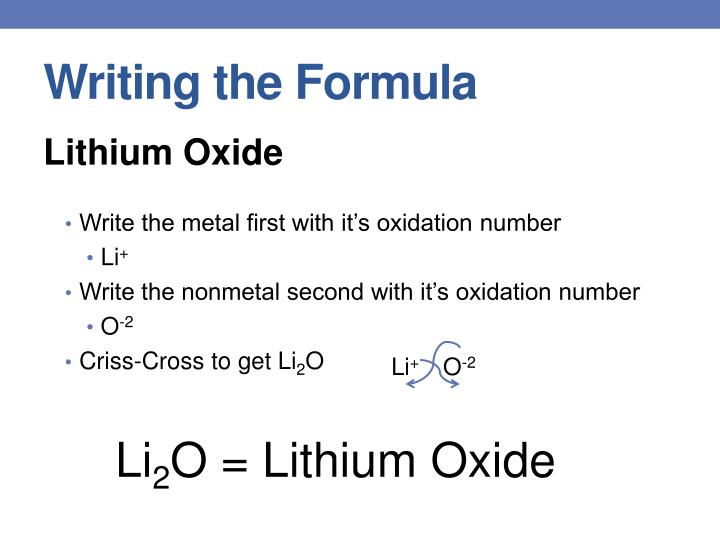
Chemistry can be widely divided into main. Predict the formula of an ionic compound. In this video we'll write the correct formula for lithium oxide.to write the formula for lithium oxide we’ll use the periodic table and follow some simple ru.
The Ionic Formula For Lithium Oxide Is Li2O.
Lithium oxide lithium oxide formula and structure. The cobalt atoms are formally in the +3 oxidation state, hence the iupac name lithium cobalt oxide. What is the formula for lithium oxide.
It Denotes The Number Of Atom Of Different Elements Present In.
Pbo is lead (ii) oxide that is reduced to lead (pb) and carbon or c is oxidized to co2 or carbon dioxide. A reducing agent (also called a reductant, reducer, or electron donor) is an element or compound that loses or “donates” an electron to an electron recipient (called the oxidizing agent, oxidant, or oxidizer) in a redox. In chemistry, the formula weight is a quantity computed by multiplying the atomic weight (in atomic mass units) of each element in a chemical formula by the number of atoms of that element present in the formula, then adding all of these products together.
